

Remote/Direct Support / By Desirea Bedel
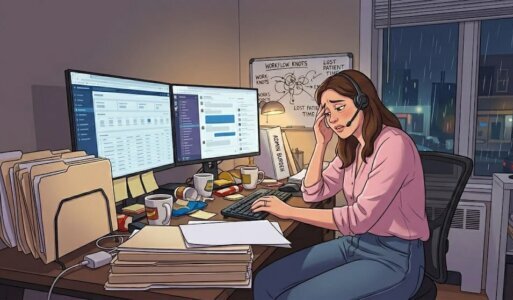
Nobody gets into remote support to make phone calls confirming that someone is fine. But that’s where a lot of hours go – proactive check-ins that exist not because a client needs support, but because the team has no passive signal that they don’t.
It’s not a staffing problem. It’s an infrastructure problem. When safety coverage is incomplete, whether at home during unsupported hours or in the community during outings, teams compensate with manual effort. And that effort adds up in ways that rarely show up on a single line of a budget, but that every coordinator feels by the end of a shift.
Check-in calls are the obvious one. When a client is home alone and there’s no passive signal that things are okay, the team calls. When a client is at a program and the only way to confirm they’re safe is to reach out, the team calls. These calls aren’t wasted, they’re filling a real gap. But they’re filling it with staff time that could go somewhere else.
The less visible drain is what happens after an incident. When something goes wrong and the team doesn’t have real-time location data or an automatic alert, response is slower. Documentation gets pieced together after the fact. Follow-up takes longer. And if the incident happened in the community or during an unsupported home hour, the timeline can be genuinely hard to reconstruct, which creates compliance headaches on top of everything else.
AllWell is a non-invasive 4G-connected safety device that’s available as a pendant or a smartwatch with automatic fall detection, live GPS, two-way calling, and an SOS button. No phone required. It travels with the client through every room of the home and every setting in the community, providing the same coverage at the kitchen table as it does at the grocery store.
When care teams have that passive signal (fall detection running, GPS active, SOS available) the volume of precautionary check-in calls drops. RSPs aren’t calling to confirm everything is okay; they’re alerted if it isn’t. That frees up real time across a shift and redirects attention toward clients who actually need active support.
When something does go wrong, the response is faster. Location is already known. The team can act immediately, talking the client through the situation, dispatching backup, or coordinating with emergency services, rather than spending the first several minutes figuring out where the client is and what happened. Faster response also means cleaner documentation, which saves time on compliance and reporting on the back end.
AllWell’s centralized management portal gives care teams a single place to manage every client – updating emergency contacts, setting geo-fence boundaries, reviewing alert histories, and pulling compliance reports. No separate system, no duplicate data entry, no hunting across platforms. As your client base grows, the administrative overhead stays flat rather than scaling with it.
Fewer precautionary check-in calls. Faster incident response. Cleaner documentation. Compliance reporting that doesn’t require reconstructing events from memory. Across a full client roster, those gains translate to meaningful reductions in staff time and operational cost and to a care team that’s spending its hours on the work that actually requires them.
